<?xml version="1.0" encoding="utf-8"?>
<feed xmlns="http://www.w3.org/2005/Atom">
    <title>pauly-woggin&apos;</title>
    <link rel="alternate" type="text/html" href="http://www.paulmbraun.com/" />
    <link rel="self" type="application/atom+xml" href="http://www.paulmbraun.com/atom.xml" />
    <id>tag:www.paulmbraun.com,2008-10-06://9</id>
    <updated>2008-11-19T18:48:55Z</updated>
    <subtitle>musings and ramblings of paul m braun, aspiring product designer, workplace innovator, and talent strategist</subtitle>
    <generator uri="http://www.sixapart.com/movabletype/">Movable Type Pro 4.31-en</generator>

<entry>
    <title>Reflection #5 - Over-reaching</title>
    <link rel="alternate" type="text/html" href="http://www.paulmbraun.com/2008/11/reflection-5---over-reaching.html" />
    <id>tag:paulmbraun.com,2008:/blog//9.1754</id>

    <published>2008-11-19T18:38:44Z</published>
    <updated>2008-11-19T18:48:55Z</updated>

    <summary>Didn&apos;t really have time to post anything this past weekend, and don&apos;t really have time right now, but this&apos;ll be a short one. Now that the quarter&apos;s almost over, things are beginning to pile up and there&apos;s a lot to...</summary>
    <author>
        <name>pmb</name>
        <uri>http://paulmbraun.com</uri>
    </author>
    
        <category term="Design Reflections" scheme="http://www.sixapart.com/ns/types#category" />
    
    
    <content type="html" xml:lang="en" xml:base="http://www.paulmbraun.com/">
        <![CDATA[<p>Didn't really have time to post anything this past weekend, and don't really have time right now, but this'll be a short one.</p>

<p>Now that the quarter's almost over, things are beginning to pile up and there's a lot to do in pretty much all my classes.  I'm mildly concerned that I might not actually finish them all -- which is not really a good thing.  Personally, I don't think the primary cause of this is procrastination (I don't know if those around me might say otherwise), but rather, not doing a very good job of estimating scope.  As in, "how much can I realistically accomplish within the given time period?" -- whether it's just a 3-day project or one that spans the entire quarter.</p>

<p>With at least one of my classes, I probably picked a project that was a little more involved than what the quarter allowed for.  I've already scaled it back from my original idea, but I'm still struggling to finish.</p>

<p>How do you find that balance between pursuing something especially significant and involved, and pursuing something that can assuredly be finished in a short timeframe?</p>

<p>I don't want to simply go through the motions in my projects, because I won't learn as much doing that.  But I would like to actually finish them...</p>]]>
        
    </content>
</entry>

<entry>
    <title>Thoughts from a Green CPG Panel Discussion</title>
    <link rel="alternate" type="text/html" href="http://www.paulmbraun.com/2008/11/thoughts-from-a-panel-discussi.html" />
    <id>tag:paulmbraun.com,2008:/blog//9.1753</id>

    <published>2008-11-11T11:33:08Z</published>
    <updated>2008-11-11T12:33:48Z</updated>

    <summary>I attended a panel on Sustainable Consumer Products tonight at the GSB. There were a couple brand managers from Method, one from Clorox GreenWorks, and the Global Sustainability Lead from IDEO. Interesting discussion, with some surprising overlaps with our recent...</summary>
    <author>
        <name>pmb</name>
        <uri>http://paulmbraun.com</uri>
    </author>
    
        <category term="Design Reflections" scheme="http://www.sixapart.com/ns/types#category" />
    
        <category term="Strategy &amp; Process" scheme="http://www.sixapart.com/ns/types#category" />
    
    
    <content type="html" xml:lang="en" xml:base="http://www.paulmbraun.com/">
        <![CDATA[<p>I attended a panel on Sustainable Consumer Products tonight at the GSB.  There were a couple brand managers from <a href="http://www.methodhome.com/">Method</a>, one from <a href="http://www.cloroxgreenworks.com">Clorox GreenWorks</a>, and the Global Sustainability Lead from <a href="http://www.ideo.com">IDEO</a>.  Interesting discussion, with some surprising overlaps with our recent design projects in ME-313, one having to do with health attitudes and habits, and the other exploring energy efficiency in consumers.</p>

<p>While health, energy efficiency, and environmentally friendly cleaning products have some significant differences, there's an interesting correlation in the attitudes and behaviors of consumers.  Much of what the panel discussed were familiar insights observed through our needfinding interviews on both projects.</p>

<p>For example, I was surprised to learn that Method chooses to attract consumers not by touting  the environmental friendliness of their products, but rather, with sleek and sexy packaging design that "pops" on the store shelves and just begs a consumer to take a bottle home.  Their goal is to design a bottle that looks so good, consumers will feel comfortable leaving it out on the counter all the time.  Only over time, as the consumer becomes familiar and comfortable with the product does Method expect them to read the label and learn about how environmentally conscious Method is.</p>]]>
        <![CDATA[<p>I thought this was a very significant point, and gets at the concept of creating a "head fake" for the consumer: convincing them to buy into a better product--in this case, environmentally--without them even knowing it.  Do consumers actually need to understand and actively elect to behave in an environmentally friendly or a healthy way?  Method would probably say No, and much of our needfinding insights would support this.  If the end result is the desired behavior, why fight consumer resistance?</p>

<p>It was also interesting to hear about the obstacles faced in creating a "Green" line of products.  "Green" has become a vastly overused term that places a number of preconceptions and ideas in consumers' minds.  For example, with respect to cleaning products, Clorox had to battle the common perception that "green" = "less effective".  It had become ingrained in consumers' minds that purchasing an environmentally friendly cleaning product meant sacrificing cleaning power, and Clorox had a difficult time combating this.  Facing such an uphill battle, it was especially important for them to ensure that the GreenWorks line worked every bit as well as the rest of Clorox's lineup.</p>

<p>For the panel, "Green" was just another business proposition.  They all took care not to overly promote this single aspect, at the risk of boxing themselves into a small and potentially constraining niche.  For consumers, function and form still take first priority, and the "green-ness" of a product can not impact this.  The speaker from IDEO brought up an interesting point to illustrate this -- a newly designed milk jug that greatly improves the environmental and financial aspects of the supply side of the milk business -- but failed to meet the basic demand of pouring easily (<a href="http://www.nytimes.com/2008/06/30/business/30milk.html">Good NY Times article here</a>).  Simply being environmentally friendly will never be enough to develop broad consumer appeal.</p>

<p>These were just a few of the points discussed, but one of my key takeaways was that consumers seem like very consistent creatures.  Whether it's health, energy usage, or green cleaning products, consumers have a similar set of basic demands and needs, and it's critical that any effective solution meet these before attempting to modify any other behavior.</p>]]>
    </content>
</entry>

<entry>
    <title>DP1 - Flat-Pack Disaster Relief</title>
    <link rel="alternate" type="text/html" href="http://www.paulmbraun.com/2008/11/dp1---flat-pack-disaster-relie.html" />
    <id>tag:paulmbraun.com,2008:/blog//9.1752</id>

    <published>2008-11-03T05:59:41Z</published>
    <updated>2008-11-03T09:36:34Z</updated>

    <summary>For this design project, we had to create a solution for a cheap, easily distributed, low payload air-droppable disaster shelter that had be easily or automatically deployable. These were to be designed for mass manufacture and to be used primarily...</summary>
    <author>
        <name>pmb</name>
        <uri>http://paulmbraun.com</uri>
    </author>
    
        <category term="ME-313 (Human Values &amp; Innovations in Design)" scheme="http://www.sixapart.com/ns/types#category" />
    
    
    <content type="html" xml:lang="en" xml:base="http://www.paulmbraun.com/">
        <![CDATA[<p>For this design project, we had to create a solution for a cheap, easily distributed, low payload air-droppable disaster shelter that had be easily or automatically deployable.  These were to be designed for mass manufacture and to be used primarily in developing nations in massive disaster events.  Language differences and potential illiteracy was to be taken into account.</p>

<p>My team began by outlining and prioritizing the problem's design constraints.  We felt that the most important criteria were collapsibility/packing efficiency and instant deployment and usability.</p>

<p>We found inspiration in airplane emergency inflatable slides and life jackets, automobile air bags and sun shades, insulating foam, and collapsible laundry hampers.  Driven by cost and deployment speed, we decided to build on the laundry hamper and sun shade ideas, and created this concept:</p>

<p><span class="mt-enclosure mt-enclosure-image" style="display: inline;"><img alt="Full.jpg" src="http://paulmbraun.com/blog/DP1/Full.jpg" width="352" height="280" class="mt-image-center" style="text-align: center; display: block; margin: 0 auto 20px;" /></span></p>

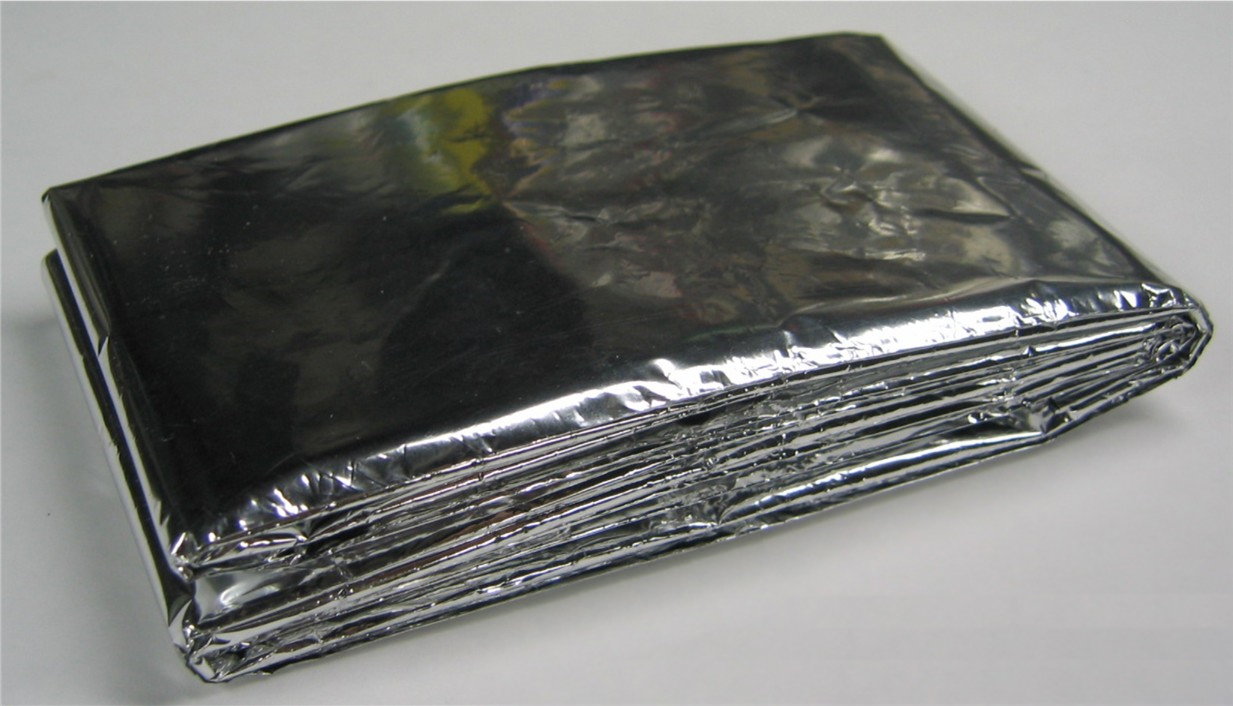
<p>Our concept would be palletized and air-dropped in a disaster zone, where a user would be able to easily transport it to the desired location.  Once there, a simple tug on a cord would release folded spring steel hoops that would pop up to form the structure of the shelter.  The walls of the structure, a heat-reflective Mylar-like sheet, would unfold with the hoops.</p>

<p><span class="mt-enclosure mt-enclosure-image" style="display: inline;"><img alt="Instruction.jpg" src="http://paulmbraun.com/blog/DP1/Instruction.jpg" width="165" height="169" class="mt-image-none" style="" /></span><span class="mt-enclosure mt-enclosure-image" style="display: inline;"><img alt="Blanket copy.jpg" src="http://paulmbraun.com/blog/DP1/Blanket%20copy.jpg" width="300" height="172" class="mt-image-none" style="" /></span></p>

<p>Deployed, this half-domed structure would accommodate a family of 4, although it would also be able to collapse to nearly 5% of its deployed volume for efficient packing and shipping.</p>

<p><span class="mt-enclosure mt-enclosure-image" style="display: inline;"><img alt="Closed.jpg" src="http://paulmbraun.com/blog/DP1/Closed.jpg" width="316" height="305" class="mt-image-center" style="text-align: center; display: block; margin: 0 auto 20px;" /></span></p>

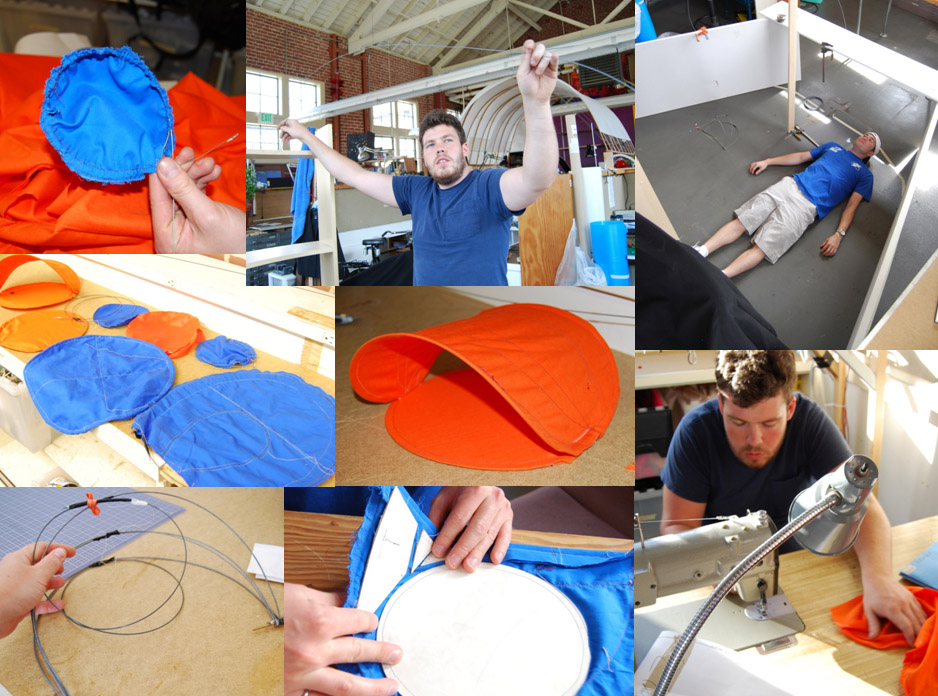
<p>Rapid prototyping was the primary focus in this exercise, and as such, we created a wide variety of mock-ups, ranging from small wire and fabric disks illustrating the unfolding process to a full-scale walkthrough model that allowed us to visualize the actual space.</p>

<p><span class="mt-enclosure mt-enclosure-image" style="display: inline;"><img alt="Protomontage.jpg" src="http://paulmbraun.com/blog/DP1/Protomontage.jpg" width="469" height="348" class="mt-image-center" style="text-align: center; display: block; margin: 0 auto 20px;" /></span></p>

<p>We were pretty pleased with our concept, and felt that it successfully addressed the problem.  Aided by our successive iterations of prototypes, we achieved our goals of maximizing the shipping/packing efficiency, minimizing the deployment</p>]]>
        
    </content>
</entry>

<entry>
    <title>Reflection #4 - Goals</title>
    <link rel="alternate" type="text/html" href="http://www.paulmbraun.com/2008/10/reflection-4---goals.html" />
    <id>tag:paulmbraun.com,2008:/blog//9.1751</id>

    <published>2008-10-27T06:47:16Z</published>
    <updated>2008-10-27T09:16:36Z</updated>

    <summary>Last week, I realized that with all the time I&apos;ve been devoting to my classwork and projects, perhaps I&apos;ve been missing out on some of the other important aspects of life out here. I remembered my forgotten list of goals...</summary>
    <author>
        <name>pmb</name>
        <uri>http://paulmbraun.com</uri>
    </author>
    
        <category term="Design Reflections" scheme="http://www.sixapart.com/ns/types#category" />
    
    
    <content type="html" xml:lang="en" xml:base="http://www.paulmbraun.com/">
        <![CDATA[<p>Last week, I realized that with all the time I've been devoting to my classwork and projects, perhaps I've been missing out on some of the other important aspects of life out here.  I remembered my forgotten list of goals that I made before departing Chicago, and promised to review them for this week's reflection.</p>

<p>For the most part, I've made some progress in each area, although there's definitely room for improvement, especially on the bigger-picture goals and the others that can't be achieved solely inside the classroom.  Something to keep in mind at least, as I navigate the next couple years at the JPD.</p>

<p><br />
1) <strong>Become a better prototyper (both rapid and refined)</strong> - definitely improving with all my design projects in class</p>

<p>2) <strong>Learn to weld</strong> - had my first experience welding last week, with surprisingly encouraging results!</p>

<p>3) <strong>Improve soldering skills and circuit design </strong></p>

<p>4) <strong>Become a better sketcher </strong>- getting there, between the sketching sessions and art classes</p>

<p>5) <strong>Learn to design/spec a bathroom or kitchen (sketching, colors, textures, etc) </strong>- learning a lot about colors and textures in Art so far, although not kitchen/bath specific</p>

<p>6) <strong>Go from identifying/appreciating good design to being able to create my own good designs</strong> - just a slow, gradual process that'll take practice</p>

<p>7) <strong>Figure out where I fit in the whole design world and design cycle</strong> - hoping to figure this one out in the next 2 years, we'll see...</p>

<p>8) <strong>Figure out my true long-term life and career aspirations</strong> - ditto...</p>

<p>9) <strong>Be less risk and change-averse</strong> - definitely feeling more comfortable getting outside my comfort zone, between the supportive Loft community and all the improv exercises</p>

<p>10) <strong>Develop my professional network</strong> - haven't done nearly enough with this yet, with professors' office hours, seminars, local design events, etc.</p>

<p>11) <strong>Develop a new media profile (website, resume, letterhead, etc)</strong></p>

<p>12) <strong>Improve web programming skills</strong></p>

<p>13) <strong>Become a better photographer/videographer</strong> - find myself "seeing" good photos and wishing I had a camera with me more often</p>

<p>14) <strong>Improve computer modelling skills</strong><br />
</p>]]>
        
    </content>
</entry>

<entry>
    <title>Comments Enabled</title>
    <link rel="alternate" type="text/html" href="http://www.paulmbraun.com/2008/10/comments-enabled.html" />
    <id>tag:paulmbraun.com,2008:/blog//9.1750</id>

    <published>2008-10-20T11:26:57Z</published>
    <updated>2008-10-20T11:29:58Z</updated>

    <summary>Just a blog formatting update - I changed the Comments settings, so anyone who previously tried to leave a note can now do so without being required to register or provide an email address. Unleash the questions, comments, and snide...</summary>
    <author>
        <name>pmb</name>
        <uri>http://paulmbraun.com</uri>
    </author>
    
    
    <content type="html" xml:lang="en" xml:base="http://www.paulmbraun.com/">
        <![CDATA[<p>Just a blog formatting update -</p>

<p>I changed the Comments settings, so anyone who previously tried to leave a note can now do so without being required to register or provide an email address.</p>

<p>Unleash the questions, comments, and snide remarks...</p>]]>
        
    </content>
</entry>

<entry>
    <title>Reflection #3 - Time</title>
    <link rel="alternate" type="text/html" href="http://www.paulmbraun.com/2008/10/reflection-3.html" />
    <id>tag:paulmbraun.com,2008:/blog//9.1748</id>

    <published>2008-10-20T09:37:17Z</published>
    <updated>2008-10-20T10:38:56Z</updated>

    <summary>So here we are, at the start of the 5th week at the JPD (that&apos;s the Joint Program in Design for the non-initiated out there). I actually had to check a calendar to figure out just how long I&apos;ve been...</summary>
    <author>
        <name>pmb</name>
        <uri>http://paulmbraun.com</uri>
    </author>
    
        <category term="Design Reflections" scheme="http://www.sixapart.com/ns/types#category" />
    
    
    <content type="html" xml:lang="en" xml:base="http://www.paulmbraun.com/">
        <![CDATA[<p>So here we are, at the start of the 5th week at the JPD (that's the Joint Program in Design for the non-initiated out there).  I actually had to check a calendar to figure out just how long I've been doing the design thing out here.  Days seem to both fly by and drag on forever at the same time.  It was just a couple days ago that I was reflecting on the progress I'd made in just the first 2 weeks...   ...and then another 2 weeks just passed.</p>

<p>Lately, I've been trying to be at the Design Loft (my home away from home) by around 9-10am each day, and I come home somewhere between 1-4am, pretty much just to sleep.  Getting to bed by 2am now feels like a pretty good early night.</p>

<p>I'm not sure whether I am slow, inefficient or just plain busy.  It's probably a mix of all three, although I honestly don't find myself wasting that much time at the Loft (maybe my loft-neighbors would disagree).</p>

<p>Everyone who's been through this before tells me that it's just a matter of figuring out priorities, setting time limits for yourself, and just working faster.  So far that hasn't really happened for me.  On the one hand, I don't want to work myself to death and make life miserable for the next two years.  However, on the other hand, I also want to get as much out of this program as I can, not cutting corners or shortchanging myself.  It's going to be a difficult balance, especially for someone as particular and prone to perfectionism as myself.</p>

<p>At the moment, I find myself treading water furiously, and just barely keeping afloat.</p>

<p>There's so much more at the JPD, Stanford, and in the Bay Area than just classwork, and I certainly don't want to miss out on anything.  Personal connections and professional networks; interesting seminars, lectures and guest speakers; pursuit of my greater career and life goals; on-campus activities... the list goes on.</p>

<p>Before I moved out to California, I started a list of goals for the next two years.  With all the craziness of the last few weeks, I actually hadn't even thought about that list since leaving Chicago, until just now.  I'd probably be well-served to take another look, and evaluate whether my efforts thus far have been focused on those goals.  Just guessing, I think I've probably gotten a little carried away with all my projects and a little too bogged down in the details, and have been missing the bigger picture of why I'm here.</p>

<p>I'll report back next week with my findings.</p>]]>
        
    </content>
</entry>

<entry>
    <title>DP0 - Bridging the Digital-Physical Divide</title>
    <link rel="alternate" type="text/html" href="http://www.paulmbraun.com/2008/10/dp0---bridging-the-digital-phy.html" />
    <id>tag:paulmbraun.com,2008:/blog//9.1747</id>

    <published>2008-10-13T17:39:49Z</published>
    <updated>2008-10-20T10:49:09Z</updated>

    <summary>Our first design project for ME313, Human Values &amp; Innovation in Design, was a short two-day project on the divide between the digital and physical worlds, especially as it related to digital assets and memories. Problem Statement: The digital age...</summary>
    <author>
        <name>pmb</name>
        <uri>http://paulmbraun.com</uri>
    </author>
    
        <category term="ME-313 (Human Values &amp; Innovations in Design)" scheme="http://www.sixapart.com/ns/types#category" />
    
    
    <content type="html" xml:lang="en" xml:base="http://www.paulmbraun.com/">
        <![CDATA[<p>Our first design project for ME313, <em>Human Values & Innovation in Design</em>, was a short two-day project on the divide between the digital and physical worlds, especially as it related to digital assets and memories.</p>

<p><strong>Problem Statement:</strong><br />
The digital age has brought many affordances such as digital imaging and easy video recording, but their ease of use has not been without a cost.  The success of digital technologies has created a deep gulf between physical experiences and digital ones, and experiences such as passing a photograph around has almost vanished entirely.  Even though we have evolved as creatures who have an intimate relationship with the physical world, our digital experiences underutilize our intuitive understanding of physical spaces and manipulating physical objects.</p>

<p>The ease and low cost associated with photography causes a flood of images, a huge back-end task that is difficult to get around to.  One's memories get buried among hundreds of folders.</p>

<p><strong>Design Challenge:</strong><br />
Create a novel experience in the physical world to deal with one's memories and digital assets.  Express your concept in any medium that you are comfortable with.</p>

<p><strong>Solution:</strong><br />
I began by outlining the problem I wanted to address: digital photography has made it so easy to take, edit, and store photos, I end up with thousands of pictures in countless folders on my computer that begin to lose their relevance and significance in my life.  After being filed away in deeply nested folders, I rarely revisit these pictures, perhaps when I occasionally clean out my hard drive or if I accidentally open a wrong folder.</p>

<p>Those occasions when I do browse through my old photos are wonderful.  I enjoy the element of surprise and unexpectedness at stumbling upon these memories and reminiscing.  Unfortunately, this is a rare occurrence.</p>

<p>With this in mind, I raised the question, "Can I recreate this experience of surprise and delight on a more regular basis?"</p>]]>
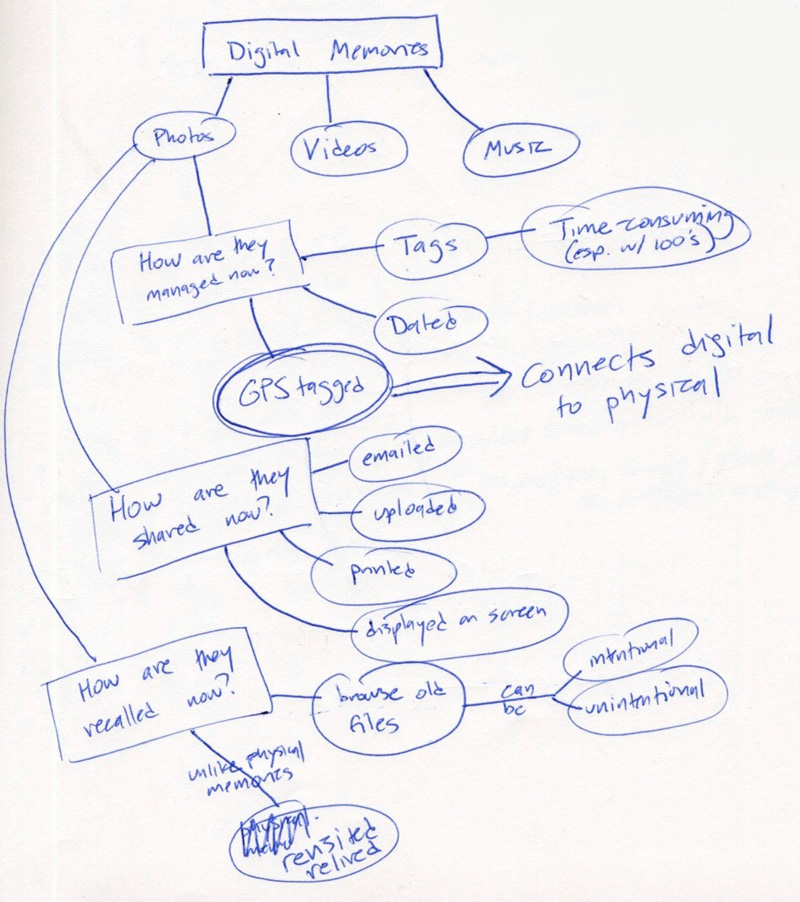
        <![CDATA[<p>Creating a mind map of where digital photos lack a clear connection to the physical world, I sought to identify potential ideas to combine with my surprise element.  However, I found that for the most part, there were good analogies equating digital photography with analog photography.  For example, both can be dated, captioned, stored in albums, and easily shared with friends.</p>

<p><span class="mt-enclosure mt-enclosure-image" style="display: inline;"><a href="http://paulmbraun.com/blog/assets_c/2008/10/dp0-mindmap.html" onclick="window.open('http://paulmbraun.com/blog/assets_c/2008/10/dp0-mindmap.html','popup','width=800,height=902,scrollbars=no,resizable=no,toolbar=no,directories=no,location=no,menubar=no,status=no,left=0,top=0'); return false"><img alt="dp0-mindmap.jpg" src="http://paulmbraun.com/blog/dp0-mindmap.jpg" width="300" height="338" class="mt-image-center" style="" /></a></span></p>

<p>So instead, I looked for a connection between the digital and physical worlds of photography.  Here, I stumbled upon one of the few aspects that truly bridges the divide <a href="http://en.wikipedia.org/wiki/Geotagging">geotagging</a>, an increasingly popular concept that tags digital photos with GPS coordinates.  Although the idea is not so new, it is only within the last year or two that cameras are being manufactured with an internal GPS unit that enables automatic geotagging.</p>

<p>Combining my two insights, I developed my solution: an application for an IPhone, laptop, or other portable media device that compares your current location with the GPS coordinates on the photos in your device's library.  When the application finds a match, the photo automatically pops up on the screen, creating surprise and unexpectedness, along with reminiscing and recalling old memories.</p>

<p><span class="mt-enclosure mt-enclosure-image" style="display: inline;"><a href="http://paulmbraun.com/blog/assets_c/2008/10/dp0-notes2.html" onclick="window.open('http://paulmbraun.com/blog/assets_c/2008/10/dp0-notes2.html','popup','width=800,height=460,scrollbars=no,resizable=no,toolbar=no,directories=no,location=no,menubar=no,status=no,left=0,top=0'); return false"><form mt:asset-id="84" class="mt-enclosure mt-enclosure-image" style="display: inline;"><img alt="dp0-notes.jpg" src="http://paulmbraun.com/blog/dp0-notes.jpg" width="400" height="230" class="mt-image-center" style="" /></span></a></form></p>

<p>The device would need only an internal GPS chip, which is becoming common in portable media devices, and a library of uploaded photos.  The application would simply be a program running in the background of the device that awakened when a photo match was found.</p>

<p>I thought this concept would be especially meaningful for frequent business travelers who spend enough time on the road and in airports that it becomes easy to forget where one has previously visited.</p>

<p>Given the extremely short timeframe and broad scope of the project, I felt very proud of my concept.  I was able to create a novel, yet feasible solution to the defined problem, and present it using a clear and compelling story.</p>

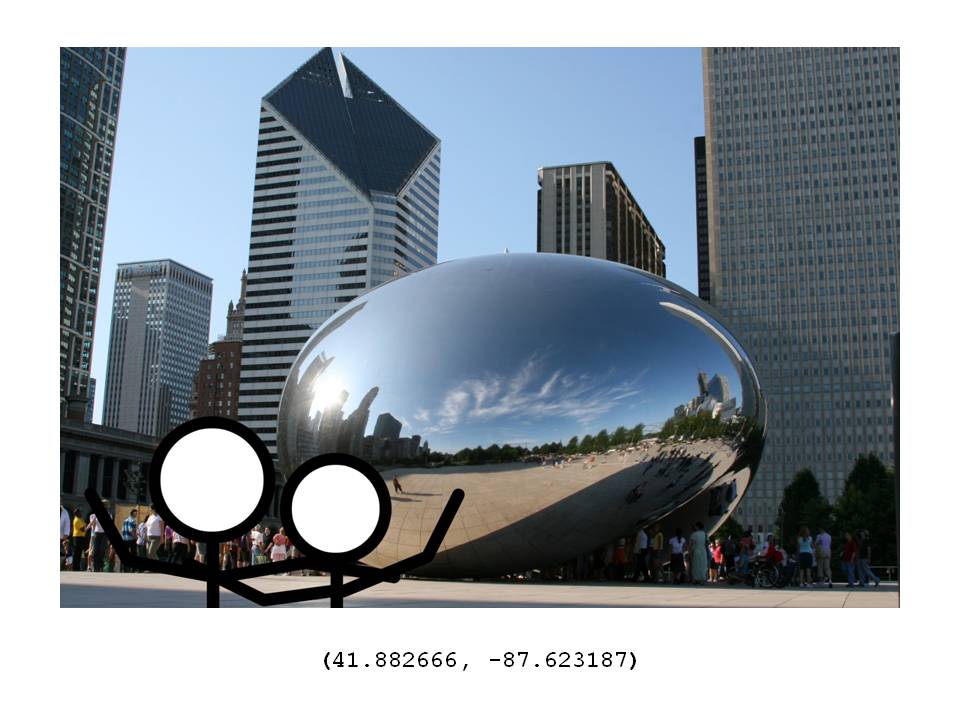
<p>Here's a step-by-step example of my concept in action:</p>

<p><span class="mt-enclosure mt-enclosure-image" style="display: inline;"><img alt="Slide2.JPG" src="http://paulmbraun.com/blog/DP0/Slide2.JPG" width="350" height="263" class="mt-image-none" style="" /></span><br />
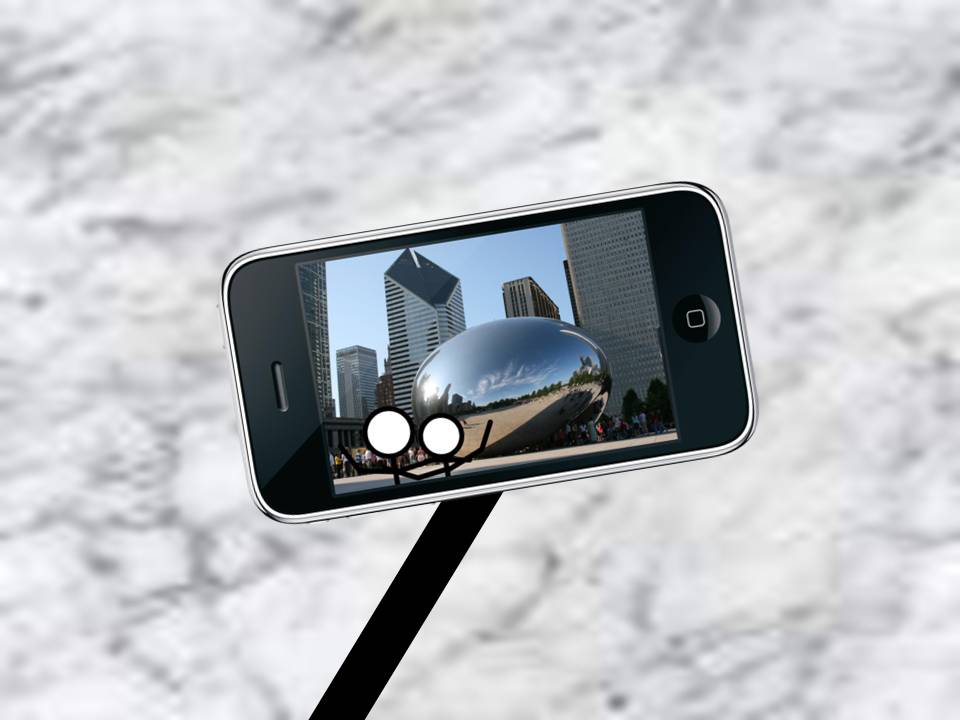
Step 1: Visit some destination on vacation (e.g. Chicago)</p>

<p><span class="mt-enclosure mt-enclosure-image" style="display: inline;"><img alt="Slide3.JPG" src="http://paulmbraun.com/blog/DP0/Slide3.JPG" width="350" height="263" class="mt-image-none" style="" /></span><br />
Step 2: Take a photo</p>

<p><span class="mt-enclosure mt-enclosure-image" style="display: inline;"><img alt="Slide4.JPG" src="http://paulmbraun.com/blog/DP0/Slide4.JPG" width="350" height="263" class="mt-image-none" style="" /></span><br />
Step 3: Camera automatically tags photo with your current location</p>

<p>...Some time passes...<br />
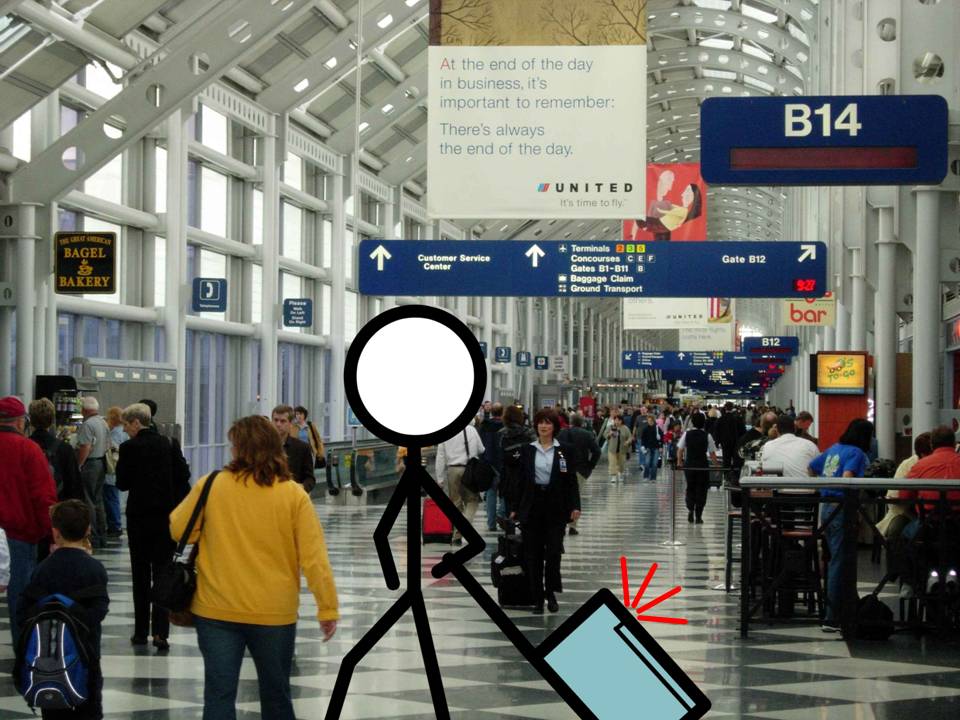
...Re-visit destination, perhaps on business (e.g. stopover in O'Hare Airport)</p>

<p><br />
<span class="mt-enclosure mt-enclosure-image" style="display: inline;"><img alt="Slide6.JPG" src="http://paulmbraun.com/blog/DP0/Slide6.JPG" width="350" height="263" class="mt-image-none" style="" /></span><br />
Step 4: Application matches current location with coordinates of old photo in library</p>

<p><span class="mt-enclosure mt-enclosure-image" style="display: inline;"><img alt="Slide7.JPG" src="http://paulmbraun.com/blog/DP0/Slide7.JPG" width="350" height="263" class="mt-image-none" style="" /></span><br />
Step 5: Image displays on laptop, cell phone, MP3 player, etc.</p>

<p><span class="mt-enclosure mt-enclosure-image" style="display: inline;"><img alt="Slide8.JPG" src="http://paulmbraun.com/blog/DP0/Slide8.JPG" width="350" height="263" class="mt-image-none" style="" /></span><br />
Step 6: Surprise + Memories = Warm Fuzzies</p>]]>
    </content>
</entry>

<entry>
    <title>Reflection #2 - Frustrations &amp; Inspirations</title>
    <link rel="alternate" type="text/html" href="http://www.paulmbraun.com/2008/10/design-reflection-2---frustrat.html" />
    <id>tag:paulmbraun.com,2008:/blog//9.1745</id>

    <published>2008-10-06T05:18:42Z</published>
    <updated>2008-10-20T10:29:06Z</updated>

    <summary>I&apos;ve come to the end of my second week at Stanford (feels more like second month), and I think I can summarize it so far as being frustratingly inspiring. Perhaps it&apos;s a little oxymoronic or grammatically incorrect, but I think...</summary>
    <author>
        <name>pmb</name>
        <uri>http://paulmbraun.com</uri>
    </author>
    
        <category term="Design Reflections" scheme="http://www.sixapart.com/ns/types#category" />
    
    
    <content type="html" xml:lang="en" xml:base="http://www.paulmbraun.com/">
        <![CDATA[<p>I've come to the end of my second week at Stanford (feels more like second month), and I think I can summarize it so far as being <em><strong>frustratingly inspiring</strong></em>.  Perhaps it's a little oxymoronic or grammatically incorrect, but I think it's a pretty accurate description of how things have progressed through the first couple weeks of projects and classes.</p>

<p>For example, take my first design project completed for <em>Human Values and Innovations in Design</em>, which involved developing a concept to bridge the digital-physical divide of one's memories and digital assets (namely photos).  We received the assignment on the first day of class, and presented our ideas just two days later.</p>

<p>In two short days, I came up with what I thought was a fantastic idea, along with an even better presentation -- I could hardly wait to tell everyone about it.  When it came time to present, I think most of the class thought my idea was pretty solid, and they definitely liked the presentation.  They said it was engaging, charming, convincing -- certainly the highlight of my Powerpoint career thus far.</p>

<p>After the whole class had presented, general consensus was that we had done impressive work in an unbelievably short amount of time.  I even recall the words "blown away" being used by the professor once or twice.</p>

<p>However, before I even had a chance to bask in my own glory, he said, "That was great, now here's your next project."</p>

<p>Wait a second... what?  Don't we get some time off to relax and rest on our laurels?  We all had such great ideas -- surely you don't expect us to come up with another one so soon?</p>

<p>Such is life at the Stanford Joint Program in Design.  Come up with one great idea, and then do it again.  And again.   And again.</p>

<p>I suppose that's the point of the whole program - to teach us how to innovate on a <u>regular</u> basis.  I guess I'm just not used to innovating on much more than a once-in-a-while basis.</p>

<p>Therein lies the frustrating part of <em><strong>frustratingly inspiring</strong></em>.  Frustrating because it's not easy to come up with the best ideas ever in the history of the universe more than once a week.  Frustrating because I can think and work for hours on end without seeming to make any progress.  Frustrating because there's always room to improve on a design.</p>

<p>However, the inspiring part usually also comes just about then, like a lightbulb switching on in my head, when I am least expecting it and when frustration is at its peak.  Inspiring because there might be a glimmer of a good idea and potential for success after all.  Inspiring because just maybe I'm on the right path (for project... program... career... life, etc).  Inspiring because there are twelve brilliant other designers in my class who all get frustrated and inspired the same way I do.</p>

<p>I'm hoping it might get easier to innovate regularly with practice, but I'm doubtful.  I think this is probably how it's going to be for the rest of my life, so I'll just have to get used to being <em><strong>frustratingly inspired</strong></em> (or is it <em>inspiringly frustrated</em>?)</p>]]>
        
    </content>
</entry>

<entry>
    <title>Reflection #1 - Design/Designer Mind Map</title>
    <link rel="alternate" type="text/html" href="http://www.paulmbraun.com/2008/09/design-reflection-1---designde.html" />
    <id>tag:paulmbraun.com,2008:/blog//9.1744</id>

    <published>2008-09-29T01:41:20Z</published>
    <updated>2008-10-20T16:59:34Z</updated>

    <summary>This is the first in a number of reflections on design for the class Human Values and Innovation in Design (ME 313). This assignment entailed creating a mind map exploring the entities and relationships of Design and Designers....</summary>
    <author>
        <name>pmb</name>
        <uri>http://paulmbraun.com</uri>
    </author>
    
        <category term="Design Reflections" scheme="http://www.sixapart.com/ns/types#category" />
    
    
    <content type="html" xml:lang="en" xml:base="http://www.paulmbraun.com/">
        <![CDATA[<p>This is the first in a number of reflections on design for the class <em>Human Values and Innovation in Design</em> (ME 313).  This assignment entailed creating a mind map exploring the entities and relationships of Design and Designers.</p>

<p><span class="mt-enclosure mt-enclosure-image" style="display: inline;"><a href="http://paulmbraun.com/blog/assets_c/2008/09/Design-DesignerMindMap1.html" onclick="window.open('http://paulmbraun.com/blog/assets_c/2008/09/Design-DesignerMindMap1.html','popup','width=1024,height=759,scrollbars=no,resizable=no,toolbar=no,directories=no,location=no,menubar=no,status=no,left=0,top=0'); return false"> <img alt="Design-DesignerMindMap.jpeg" src="http://paulmbraun.com/blog/Design-DesignerMindMap.jpeg" width="480" height="356" class="mt-image-none" style="" />    </a></span></p>]]>
        
    </content>
</entry>

<entry>
    <title>Starting a New Chapter</title>
    <link rel="alternate" type="text/html" href="http://www.paulmbraun.com/2008/09/starting-a-new-chapter.html" />
    <id>tag:paulmbraun.com,2008:/blog//9.1746</id>

    <published>2008-09-22T11:14:42Z</published>
    <updated>2008-10-06T11:26:34Z</updated>

    <summary>As of today, I am once again a student. I am beginning graduate studies at Stanford University&apos;s Joint Program in Design, a collaborative and multidisciplinary program combining elements of engineering, art, business, psychology, anthropology, and marketing (among other disciplines) to...</summary>
    <author>
        <name>pmb</name>
        <uri>http://paulmbraun.com</uri>
    </author>
    
    
    <content type="html" xml:lang="en" xml:base="http://www.paulmbraun.com/">
        <![CDATA[<p>As of today, I am once again a student.  I am beginning graduate studies at Stanford University's Joint Program in Design, a collaborative and multidisciplinary program combining elements of engineering, art, business, psychology, anthropology, and marketing (among other disciplines) to build a strong foundation in design, design thinking and problem solving methods.</p>

<p>I will be pursuing a Masters of Science in Mechanical Engineering, with a specialization in Product Design, expecting to graduate in June 2010.  I am one of 13 very diverse designers in this year's class, and I'm looking forward to an intense but exhilarating 2 years at Stanford.</p>

<p>One of my classes this quarter will include regular blog postings and reflections on design, but I am hoping to expand this to all of my design activities, in an effort to present and archive my work here.</p>

<p>Check back occasionally to see what kind of fun stuff I can get myself into, and as always, feel free to contact me with questions, comments, or discussion.</p>

<p>-paul<br />
</p>]]>
        
    </content>
</entry>

<entry>
    <title>Awesomest sink ever</title>
    <link rel="alternate" type="text/html" href="http://www.paulmbraun.com/2007/12/awesomest-sink-ever.html" />
    <id>tag:paulmbraun.com,2007:/blog//9.1697</id>

    <published>2007-12-08T09:25:15Z</published>
    <updated>2008-09-29T22:56:46Z</updated>

    <summary>If it&apos;s not the best-looking sink I&apos;ve ever seen, it&apos;s pretty close. Pretty sweet... http://www.willmaccormac.com/index.htm note: Just how abnormal does this make me? I feel the same way looking at this sink as I would watching a Bugatti Veyron go...</summary>
    <author>
        <name>pmb</name>
        <uri>http://paulmbraun.com</uri>
    </author>
    
        <category term="Sinks" scheme="http://www.sixapart.com/ns/types#category" />
    
    
    <content type="html" xml:lang="en" xml:base="http://www.paulmbraun.com/">
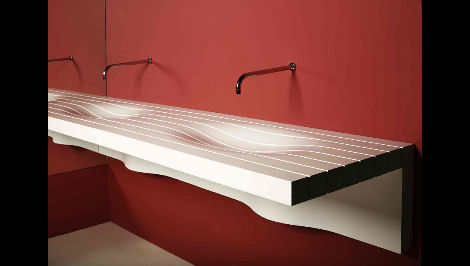
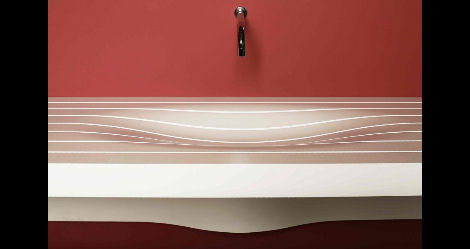
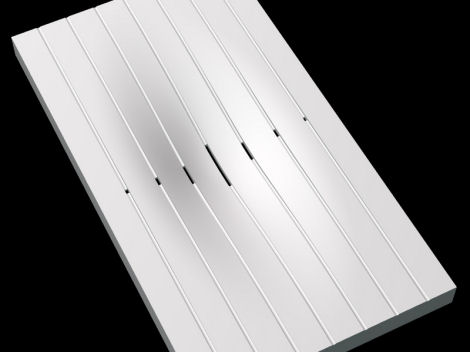
        <![CDATA[<p>If it's not the best-looking sink I've ever seen, it's pretty close.  Pretty sweet...</p>

<p><a href="http://www.willmaccormac.com/index.htm">http://www.willmaccormac.com/index.htm</a></p>

<p><span class="mt-enclosure mt-enclosure-image"><img alt="follo1.jpg" src="http://paulmbraun.com/blog/follo1.jpg" width="470" height="266" class="mt-image-left" style="float: left; margin: 0 20px 20px 0;"/></span></p>

<p><span class="mt-enclosure mt-enclosure-image"><img alt="follo2.jpg" src="http://paulmbraun.com/blog/follo2.jpg" width="470" height="249" class="mt-image-left" style="float: left; margin: 0 20px 20px 0;"/></span></p>

<p><span class="mt-enclosure mt-enclosure-image"><img alt="follo3.jpg" src="http://paulmbraun.com/blog/follo3.jpg" width="470" height="352" class="mt-image-left" style="float: left; margin: 0 20px 20px 0;"/></span></p>

<p>note: Just how abnormal does this make me?  I feel the same way looking at this sink as I would watching a Bugatti Veyron go by.  That's the kind of feeling that sink design gives me - like seeing a $1.5 million car.  What a weirdo...</p>

<p>note #2: If you aren't familiar with the Veyron, it is simply ridiculous: $1.5 million buys you an 8 liter, 16 cylinder car that can do 0-60 in 2.5 seconds, runs a 10.2 second quarter mile at 140mph, and will empty its fuel tank in 12.5 minutes going full throttle at 250mph.  Ridiculous, indeed.</p>

<p><a href="http://en.wikipedia.org/wiki/Bugatti_Veyron">http://en.wikipedia.org/wiki/Bugatti_Veyron</a></p>]]>
        
    </content>
</entry>

<entry>
    <title>Having/Eating Cake in China</title>
    <link rel="alternate" type="text/html" href="http://www.paulmbraun.com/2007/11/what-you-mean-i-cant.html" />
    <id>tag:paulmbraun.com,2007:/blog//9.1684</id>

    <published>2007-11-08T17:32:16Z</published>
    <updated>2007-11-08T17:54:57Z</updated>

    <summary>What? You mean I can&apos;t get a better product with twice as many features as the last version, delivered in half the time of my previous supplier, at half the cost? What kind of raw deal is this? Isn&apos;t China...</summary>
    <author>
        <name>pmb</name>
        <uri>http://paulmbraun.com</uri>
    </author>
    
    
    <content type="html" xml:lang="en" xml:base="http://www.paulmbraun.com/">
        <![CDATA[<p>What?  You mean I can't get a better product with twice as many features as the last version, delivered in half the time of my previous supplier, at half the cost?  What kind of raw deal is this?  Isn't China supposed to be a win-win-win deal, the low-cost manufacturing garden of Eden, Willy Wonka's outsourced candyland of injection molding and die-casting...??</p>

<p><a href="http://www.chicagotribune.com/business/chi-thu_china1108nov08,0,1541857.story">Interesting article in the Tribune today</a> about the growth of manufacturing in China.  No wonder they are having all kinds of problems.  Americans want high-quality, safe, quick, and cheap -- but don't want to pay for it.</p>

<p><br />
<strong><big>China's factories feel the squeeze</big></strong><br />
<strong>Vendors fight for work, cut costs Caught between rising costs at home and low-cost pressure abroad, some firms decide to cut corners<br />
</strong><br />
By Michael Oneal</p>

<p>Tribune staff reporter</p>

<p>8:08 AM CST, November 8, 2007</p>

<p>SHENZHEN, China</p>

<p>Sitting in a windowless conference room surrounded by the remote-control toy Ferraris and Mercedes he sells the world over, factory owner Kuma Gu summed up what it's like to manufacture products for American consumers these days.</p>

<p>"A lot of Chinese companies have a saying," he said between drags on a cigarette. "Do you want to kill yourself? Then do business with Wal-Mart."</p>

<p>Gu wasn't looking for sympathy. He has thrived for years amid the economic miracle that has transformed this one-time steamy fishing village into one of the world's largest manufacturing bases.</p>

<p>But as he discussed the lead-paint fiasco that has damaged his industry's vital relationship with U.S. shoppers, Gu put the issue in far broader context.</p>

<p>China's export machine, he said, has become a victim of its own success.<br />
</p>]]>
        <![CDATA[<p>For decades, the economic relationship between the United States and China has been based on a crystal-clear calculus: American consumers wanted low-cost goods, China delivered them.</p>

<p>But exponential growth along the sprawling Pearl River Delta just north of Hong Kong has triggered sharply rising costs for everything from labor to plastic. And as the Wal-Marts of the world continue to press for lower prices, Chinese manufacturers are getting squeezed.</p>

<p>Many factory owners, government officials and U.S. importers interviewed in China linked the toy-safety problem to this market pressure, part of the profound changes under way in an economy on the rise.</p>

<p>Just as Japan and Taiwan did before it, Southern China is struggling to mature from a Wild West economy that thrives on cheap labor and lax regulation to one valued for its technical ability and high quality. That future may come. But for now, China is like a gangly economic adolescent, fast-reaching adulthood but still prone to explosive, childlike outbursts.</p>

<p>The shift is upending many of the low-cost assumptions that have fueled China's staggering growth. For years, migrant workers have flooded to Chinese factories on the coast providing a seemingly limitless supply of dirt-cheap labor. Now, the government is trying to rebalance the economy by encouraging industrial development inland, allowing more workers to stay home and forcing companies to come to them.</p>

<p>In coastal cities like Shenzhen and Dongguan, this has translated into a labor shortage. Amid China's ravenous appetite for raw materials -- oil in particular -- other costs are rising too. Meanwhile, the flip side of the government's friendly policies inland are hostile ones for coastal industries that use lots of labor and environmental resources. Add in a rising yuan against the dollar and the region's low-cost advantage is beginning to slip away.</p>

<p>The result is that many small to mid-size outfits like Gu's find themselves locked in a new and volatile struggle for survival. All developing countries have suffered the ills of headlong industrial growth -- periods of lawlessness, environmental degradation and quality issues -- offering many reasons for China's product meltdowns. But with costs rising precipitously in China, many experts say the pressure to shave pennies through bad behavior has increased, especially as foreign buyers continue to exploit the market's chronic overcapacity by shopping door-to-door for vendors who will do whatever it takes to win business.</p>

<p>"It reaches a point where things aren't economically viable and corners get cut by subcontractors and sub-subcontractors," said Steve Vickers, head of a security company called International Risk and former commander of criminal intelligence for the Royal Hong Kong Police. "That's called capitalism, I guess. But it's reckless."</p>

<p>Made in China</p>

<p>China's problems couldn't seem more distant from the bland forest of glass office buildings lining Interstate Highway 88 in suburban Oak Brook. But in the third-floor office suite that houses RC2 Corp., toy designer Jeff Bricker is only a high-speed Internet connection away from RC2 offices in Dongguan, just north of Shenzhen.</p>

<p>Bent over a drawing table covered with plans for a new Thomas and Friends talking train set, Bricker explained how product teams in Oak Brook dream up Thomas toys, beam them to design engineers in Dongguan and wait for the products to flood back from 35 contract manufacturers so they can be sold all over the world.</p>

<p>He also lamented the damage done to the Thomas brand from RC2's recall this year of about 1.7 million lead-tainted toys.</p>

<p>"Hopefully, [parents] will realize these things can happen," Bricker said. "Hopefully, the trust will come back."</p>

<p>Curt Stoelting, RC2's chief executive, knows that hope rings hollow with parents when it comes to toy safety. He hardly thinks doing business in China is reckless, but the recalls have made him painfully aware of what can go wrong when a global supply chain snaps a link under pressure.</p>

<p>He still isn't sure exactly why lead paint ended up on many of his wildly popular train toys. He doesn't even know whether to blame the manufacturer or the company that supplied it paint.</p>

<p>"What I can tell you," Stoelting said recently after returning from China to inspect the situation, "is that corners were cut. Our very specific requirements were not followed."</p>

<p>RC2 had given its contractors price relief to cover rising costs. It had been confident that its testing procedures -- which met or exceeded industry standards -- were adequate. "But it turns out they weren't," Stoelting said. Having been lulled by his contractor's good behavior over a period of years, he added, "We took things for granted."</p>

<p>Mattel Inc., which has recalled nearly 2 million of its own lead-tainted toys this year, has told a similar story -- only its long-term contractor killed himself after being duped by a supplier. Like RC2, Mattel and many other companies subject to recalls have acknowledged that their testing procedures were woefully inadequate.</p>

<p>Quality control experts used to working in China say the mistake companies like Mattel and RC2 have made is assuming that China -- still a developing country -- offers U.S. companies a mature and stable manufacturing platform. China is certainly capable of manufacturing high-quality products. But Kurt Schneiders, co-founder of PRO QC Systems in Hong Kong, said a combination of overcapacity, lax regulation, rising costs and pressure from buyers has encouraged the desperate, uneducated or unscrupulous to do whatever it takes to win business.</p>

<p>"Nobody wants to pay for quality," Schneiders said. "Not buyers, not manufacturers."</p>

<p>Made to order</p>

<p>For Lawrence Chan, chairman of the Hong Kong Toys Council and founder of a large Mattel supplier called Wynnewood Corp., this isn't a surprise. It's simply the risk of doing business on the mainland. On a Saturday morning in his sparse but bustling office in Hong Kong's Kwun Tong District, Chan explained that the further you get down the food chain in China, the more trouble you encounter.</p>

<p>Big companies, he said, tend to have sophisticated managers who are well aware of U.S. regulations. They also recognize that skimping on paint doesn't save enough money to offset the very real risk of a recall.</p>

<p>But in China's ever-expanding market, there is always another company that will bid lower if a buyer looks hard enough. Some will even open up a new factory to get the business. Big companies under price and time pressure often subcontract to smaller ones with less sophistication and fewer resources.</p>

<p>"At large companies, management is at least informed that [using lead paint] is a no-no," Chan said. "But for subcontractors, are they totally aware? And has management informed employees?"</p>

<p>Chan insists that few Chinese companies -- even unsophisticated small ones -- would knowingly use toxic substances. But he gave the example of a small subcontractor rushing to produce 10,000 pieces on deadline.</p>

<p>"Sometimes they run out of paint for a small portion of the order," Chan explained. "Then due to ignorance they say, 'Oh, here's some paint that is similar.' Then they have a problem."</p>

<p>Chan knows that U.S. buyers face pressure to "squeeze every fraction of a penny. It's their job." But if they want quality, he said, they have to lift their heads from the price sheet and consider where they are.</p>

<p>"This has been a great lesson for everybody," he said. "Sometimes you have to pay for what you want."</p>

<p>Made to listen</p>

<p>For RC2's Stoelting, this lesson means two things. First, he knows he has to spend more money on testing in Dongguan, where RC2 has an office to engineer products, perform quality assurance and manage its large stable contract manufacturers.</p>

<p>The company has beefed up its quality control procedures to include more in-process audits and the testing of every batch of paint that comes through the door. RC2 also makes Bob the Builder, Johnny Lightning and John Deere toys, as well as children's products under The First Years and Lamaze brands.</p>

<p>The second implication of Chan's lesson, however, is more reflective of what's really going on in China.</p>

<p>Recognizing that cities like Dongguan are becoming too expensive to give him what he needs in terms of cost and efficiency, Stoelting is planning to move 200 miles inland to a 400-acre site in Wengyuan. Labor, land and taxes are cheaper there and utilities are more abundant. He studied moving as far as Vietnam, which many in the outsourcing world call "the next China."</p>

<p>The recall experience hasn't blunted Stoelting's faith in globalization. A 47-year-old former Arthur Andersen consultant, he believes companies like his are in a perpetual search for cheaper places to manufacture.</p>

<p>Made for change</p>

<p>A decade ago, when RC2 first teamed with several manufacturers to build an office-production complex in Dongguan's Chang'an district, the area was surrounded by rice paddies. Companies built multistory factories like those found in Hong Kong. Labor was so cheap that Chinese firms ignored automation and lean manufacturing techniques. Those things made sense in Japan. Here they were unnecessary.</p>

<p>Chang'an remains a rough-hewn industrial district in many respects. The smog is thick and rolling electrical blackouts are the norm. Although Jetson International Ltd., one of RC2's dedicated factories, uses rudimentary automation to produce wooden Thomas trains and track, workers still toil in the 90-degree heat with nothing but paper surgeon's masks protecting them from sawdust and other hazards. Wages have been rising, but they are still puny by Western standards. Production workers in Dongguan earn less than $150 a month.</p>

<p>Nevertheless, signs of change are everywhere. A five-star hotel has arrived, restaurants have blossomed and office towers are on the rise. The real growth is coming from computer-parts factories that are as modern as any in the world.</p>

<p>Wynnewood's Chan remembers paying workers $6 a month in the years after Deng Xiaoping opened the south for development in 1978. Even in 1989, he had to argue with his Chinese partners about putting in a fire escape in a multistory worker's dormitory with only one exit.</p>

<p>"I wasn't even asking them to pay for it," Chan said. "The value of life was very different at that time."</p>

<p>Robin Munro, research director for the China Labour Bulletin in Hong Kong said labor conditions remain primitive by U.S. standards. Dormitories are still crowded, long hours of overtime are still expected and worker safety remains a distant concept. But Monro also said the pendulum is swinging. The Pearl River Delta has developed such a dismal reputation that as industry develops inland, workers increasingly head home or never leave. That has created a labor shortage of 12 percent to 15 percent in the region.</p>

<p>Made at a price</p>

<p>At the Chitone labor market near Dongguan's gleaming new civic center recently, the shift was obvious in the interplay between potential employers and job seekers packed into the market's top two floors.</p>

<p>At one booth sat 28-year-old Li Jun, whose company makes plastic bags for supermarkets around the world. On this day, he was looking for office staff. But two months earlier he had been forced to hire an agency to travel inland to recruit factory workers to fill out the company's staff of 280.</p>

<p>Li said the worker shortage had driven wages up around 30 percent over the last three years. Production workers used to get around $100 a month. Now they are paid closer to $140. Retaining workers also means improving living conditions, albeit from rock bottom standards.</p>

<p>Li explained that in March his company added hot water to the dormitory bathrooms and put in air conditioning. The owners hired a cook to replace the meal service because workers were complaining about the food quality. The company bought a snooker table, a big movie projector for the dining</p>

<p>room and started regular exercise periods.</p>

<p>Another manufacturer, Minoya Sharehold Co., was also pushing lifestyle amenities. "We have a beautiful environment," said a colorful sign, noting the company's Ping-Pong and snooker room, as well as its basketball, volleyball and badminton courts.</p>

<p>But Yang Jianjun, a 25-year-old quality control manager, wasn't buying. Minoya was offering almost $190 a month plus overtime for quality control positions. Yang's price was closer to $270.</p>

<p>"I think the salary is too low," he said. " I don't think it would motivate me to work there."</p>

<p>Labor costs at Gu's HK (Shenzhen) Industries Ltd. have jumped by half over the last several years. But that's just the beginning. ABS plastic, a basic raw material in model cars, has more than doubled. Nickel, the key ingredient in batteries, has rocketed from around $16,000 a ton to almost $47,000. Meanwhile, everything has been made more expensive for exporters by the government's policy of letting the value of the yuan float higher in response to U.S. complaints about its trade deficit with China.</p>

<p>Safety, too, comes at a cost. Even before the toy-quality scandals, Gu said, he constantly worried about getting slipped lead paint by a supplier looking to shave pennies. So he demands certification from suppliers and insists they sign contracts taking full responsibility for a recall. He also makes sure he buys from large, established companies. All of this helps him sleep at night. But it also means he pays top dollar for paint.</p>

<p>A few years ago, he said, Mattel came to him and expressed strong interest in hiring HK to build a branded line of radio-controlled toys. The two sides had several meetings and talked about designs. But, in the end, they didn't come to terms because Gu couldn't afford it.</p>

<p>"The quality was very high and the requirements very strict," Gu explained, "but the price was no good, so we wouldn't do it."</p>

<p>A Mattel spokeswoman said the company has no record of working with HK.</p>

<p>Back in Oak Brook, RC2's Stoelting said the reason he's moving inland is that there's no way to avoid the kind of problem Gu complains of.</p>

<p>In Wengyuan, he said, higher transportation costs will be an issue for a while. But because the government is building a new road to the area connecting it to the port in Shenzhen, a 15 percent to 20 percent drop in labor rates pulls like a magnet. Moreover, by building a new compound of factories, RC2 and its partners can leap frog their current facilities. They are designing efficient, single-floor production plants equipped with more automation machinery and laid out to take advantage of lean production systems.</p>

<p>"If labor costs weren't increasing, I don't think there would be motivation to use more efficient equipment and different manufacturing techniques," Stoelting said. "But they are increasing and they're going to continue to increase."</p>

<p>U.S. companies go out of their way to preserve the kind of competition that drives down prices, said K.K. Choy, assistant general manager of Wealthwise Industrial Ltd., a large Mattel contractor. Choy explained that while Mattel gives Wealthwise a steady diet of work producing all manner of Elmo, Dora and other toys, it is also careful to channel some business to smaller firms to keep them in the game.</p>

<p>"For smaller companies, it will be a tough time to keep alive," said Choy. "But Mattel will protect them. They don't want us to get too big."</p>

<p>A Mattel spokeswoman responded that her company uses many manufacturers around the world, big and small.</p>

<p>Made to move</p>

<p>Making life increasingly complicated for the small and the weakened, however, is steadily becoming official government policy in the Pearl River Delta. Cities like Dongguan and Shenzhen are actively favoring big exporters and high-technology companies that can eventually develop their own brands and focus on the domestic market.</p>

<p>One example is a switch in the value-added tax rules that require smaller companies to put up half the tax in cash until its products are exported. Only companies with strong balance sheets can afford to do that month after month.</p>

<p>"It's a way to make life more difficult for smaller manufacturers," said Clement Chen, chairman of the Federation of Hong Kong Industries. "As the economy becomes more mature, they want more mature factories -- more value added, more brands."</p>

<p>If out-of-favor companies agree to move to inland regions, however, those rules will be revoked, Chen said.</p>

<p>Jiang Ling, Dongguan's vice mayor for economic development, said trimming overcapacity, enforcing regulation and increasing quality are not simply government objectives. With the Made in China brand under siege, it is a matter of survival.</p>

<p>"If the quality and credibility of our products is bad, that will ruin our city," Jiang said. "In the past, we paid much more attention to quantity. Now we have to pay more attention to quality."</p>

<p>Even Jiang acknowledges, however, that the transition will be difficult.</p>

<p>For 20 years, economic expansion has been the tonic that cured all ills in China. Growth in gross domestic product has been the currency of political power. Local mandarins have been judged by Beijing on their economic prowess and given resources and clout accordingly. Many officials have built a lifestyle taking bribes for looking the other way when it comes to regulation and even those that haven't see their professional advancement tied to growth in GDP, creation of jobs and general social order.</p>

<p>Jiang admits that "it will take time for different levels [of government and the business world] to accept this concept." He also said it will be a challenge to "better manage officials in government" to make sure graft and corruption don't cripple reform.</p>

<p>Some experts say that the current crisis may give reform-minded officials cover to make some tough decisions. And, already, the government is clamping down by sending out armies of quality inspectors, while recertifying exporters.</p>

<p>Nevertheless, explained Chen, the pain of transition isn't likely to end soon.</p>

<p>"It's a mega-project for the central government," he said, "and unfortunately, it can't be rushed."</p>

<p>----------</p>

<p>mdoneal@tribune.com</p>

<p>Copyright © 2007, Chicago Tribune</p>]]>
    </content>
</entry>

<entry>
    <title>Horse, then Cart -- or Cart, then Horse?</title>
    <link rel="alternate" type="text/html" href="http://www.paulmbraun.com/2007/07/horse-then-cart-or-cart-then-h.html" />
    <id>tag:paulmbraun.com,2007:/blog//9.1576</id>

    <published>2007-07-31T21:56:27Z</published>
    <updated>2007-08-09T03:19:10Z</updated>

    <summary>Question: Which is better, to identify a customer or application with a need and then develop a product or technology around it, or to develop the product or technology first and then look for the right customer or application? From...</summary>
    <author>
        <name>pmb</name>
        <uri>http://paulmbraun.com</uri>
    </author>
    
        <category term="Strategy &amp; Process" scheme="http://www.sixapart.com/ns/types#category" />
    
    
    <content type="html" xml:lang="en" xml:base="http://www.paulmbraun.com/">
        <![CDATA[<p>Question: Which is better, to identify a customer or application with a need and <u>then</u> develop a product or technology around it, or to develop the product or technology <u>first</u> and then look for the right customer or application?</p>

<p>From a user-centered design perspective, I suppose you would want to have a clearly defined need to guide your design to ensure its success.  Without a user in mind, how can you evaluate your design and decide whether it works?</p>

<p>On the other hand, it seems that this may not always be practical or realistic.  If you come across a great new technology with impressive features and benefits, you would be foolish to pass on it because nobody has yet identified a specific user or explicitly articulated a clear need.</p>

<p>So how do you balance this?  This is a problem I have been observing recently, where a company acquired some new sensing technology from an inventor that offered several impressive improvements on current sensing options.  They have been working for about a year now, but have struggled to lock up customers and meet their financial targets.</p>

<p>It's pretty clear what the advantages of this technology are.  It offers better reliability and durability than anything else available, allows for far greater design flexibility when incorporating sensing into applications and products, and has a rather advanced level of system intelligence in the form of self-monitoring and self-diagnosing.</p>

<p>However, it's less clear who can best use and benefit from this technology.  The company has yet to find that "killer application" that will launch the technology into mainstream industry and make the company millions of dollars, much like word-processing and spreadsheets did for the PC.</p>

<p>So how does a company in a situation like this succeed?  Perhaps a delicate balancing act of pushing development forward, offset with equal time and resources spent identifying key customers and applications.  This particular company may very well be too far into development for the technology to ever succeed in its current manifestation.  Maybe they need to pull back, get some input from potential customers and then proceed with the guidance and new information from users.</p>

<p>It’s like developing a new round peg made of titanium with a non-slip grip, and finding that nobody wants to buy it because they all have square holes.  Everyone likes the idea of a non-slip grip and they’re impressed by the lightweight titanium, but your customers aren’t convinced that this peg really fits their needs.  So then, what do you do at this point?  Stick to your guns, continue promoting your new peg, and search for customers until you find one that has a round hole?  What if you never find one?  That would be an awful lot of time and money wasted.</p>

<p>Perhaps the lesson is that while it’s certainly not always feasible to have an application or user with a clearly defined need in mind before starting development, it's critical to identify that user and need as quickly as possible.  They need to be questioned, interviewed, tested, observed, and every which way involved in development at the earliest possible stage.  Otherwise, you run the risk of completing development of a great new product that everybody likes, but nobody needs or wants.</p>

<p>Maybe you didn’t know pegs would be the final manifestation of your non-slip grip and titanium design when you began your research and development.  However, the moment you came to that realization, customers with peg holes should have become an integral part of your work.  That way, perhaps you might have ended up with a shiny new <u>square</u> peg made of titanium with a non-slip grip, sold millions, gone public, and become the fourth-richest person in the world.<br />
</p>]]>
        
    </content>
</entry>

<entry>
    <title>Designing From a Distance</title>
    <link rel="alternate" type="text/html" href="http://www.paulmbraun.com/2007/06/designing-from-a-distance.html" />
    <id>tag:paulmbraun.com,2007:/blog//9.1716</id>

    <published>2007-06-30T16:21:39Z</published>
    <updated>2008-02-26T02:40:26Z</updated>

    <summary>What would you make of a company that allows only their salespeople to interface with customers? What does it say about the company if their engineers don&apos;t discuss design with the customer, having little say in what they create? I...</summary>
    <author>
        <name>pmb</name>
        <uri>http://paulmbraun.com</uri>
    </author>
    
        <category term="Strategy &amp; Process" scheme="http://www.sixapart.com/ns/types#category" />
    
    
    <content type="html" xml:lang="en" xml:base="http://www.paulmbraun.com/">
        <![CDATA[<p>What would you make of a company that allows only their salespeople to interface with customers?  What does it say about the company if their engineers don't discuss design with the customer, having little say in what they create?  I have been working with a company lately that does just this--for the most part preferring that only the general manager and salespeople maintain contact with customers.  Doesn't this effectively isolate many of those who are most involved with, knowledgeable about, and responsible for the company's product offering ?</p>

<p>From what I've seen, this seems to be the usual progression:</p>

<p>1)  Customer tells Sales what he/she wants (Note: <strong>want</strong> ≠ <strong>need</strong> in many cases).<br />
2)  Sales relays Customer's wants to Engineering.<br />
3)  Engineering designs product to given specifications, and sends it back to Sales.<br />
4)  Sales presents design to Customer, who offers feedback (often likely to be negative)<br />
5)  Sales returns to Engineering and relays Customer's requested design changes.<br />
6)  Repeat Steps 3-5 <em>ad nauseam</em>--until Customer either finally accepts the design or gets sick of waiting around and finds someone else.</p>

<p>At virtually every step of the way, one party is relying on assumptions and inferences made about the other party and their wants and needs.  Add in the probability of something getting lost in translation, and we have one twisted game of "Telephone" with significant financial consequences.</p>

<p>From my perspective, it seems virtually impossible to effectively develop successful products in a reasonable timeframe when you have a system as inefficient as this.  No wonder projects are always behind schedule and customers seem perpetually annoyed!  It's not that the engineers don't know <em>how</em> to design--they just don't know <em>what</em> to design because they don't understand the need or context.</p>

<p>It's as though they are peering at the customer through a telescope--completely removed from the application and seeing only the portion of the greater picture that appears in their lens.  Most of the time, they can't even tell what they're looking at and have to rely on Sales to interpret for them.</p>

<p>Perhaps if they were involved early on, interacting with the customer from the start, they might stand a better chance of understanding the need and designing appropriately.  Projects would flow more efficiently, customers would get their products on-time and might even stay cheerful, and solutions would be far more effective.</p>

<p>Unfortunately, change is not likely in this company.  Everyone with whom I've ever discussed this not only considers it infeasible, but actually even <u>better</u> that they maintain a single point-of-contact with the customer.  That way, they reduce confusion and avoid sending conflicting messages.</p>

<p>...How unfortunate and ironic then, that confusion is the main byproduct of their current mentality.<br />
</p>]]>
        
    </content>
</entry>

<entry>
    <title>Biomimicry</title>
    <link rel="alternate" type="text/html" href="http://www.paulmbraun.com/2007/06/biomimicry.html" />
    <id>tag:paulmbraun.com,2007:/blog//9.1533</id>

    <published>2007-06-14T01:21:32Z</published>
    <updated>2007-06-14T01:31:49Z</updated>

    <summary>I came across an interesting article today in Business 2.0 about biomimicry, which is basically &quot;nature-inspired engineering&quot;. I suppose Nature has been developing products a whole lot longer than the rest of us have... I would be mildly concerned if...</summary>
    <author>
        <name>pmb</name>
        <uri>http://paulmbraun.com</uri>
    </author>
    
    
    <content type="html" xml:lang="en" xml:base="http://www.paulmbraun.com/">
        <![CDATA[<p>I came across an interesting article today in Business 2.0 about <em>biomimicry</em>, which is basically "nature-inspired engineering".  I suppose Nature has been developing products a whole lot longer than the rest of us have... I would be mildly concerned if it wasn't doing at least a halfway decent job by now...</p>

<p><a href="http://money.cnn.com/magazines/business2/business2_archive/2007/06/01/100050991/index.htm">http://money.cnn.com/magazines/business2/business2_archive/2007/06/01/100050991/index.htm</a></p>

<p>Wikipedia entry for <em>biomimicry</em>: <a href="http://en.wikipedia.org/wiki/Biomimicry">http://en.wikipedia.org/wiki/Biomimicry</a></p>]]>
        
    </content>
</entry>

</feed>